

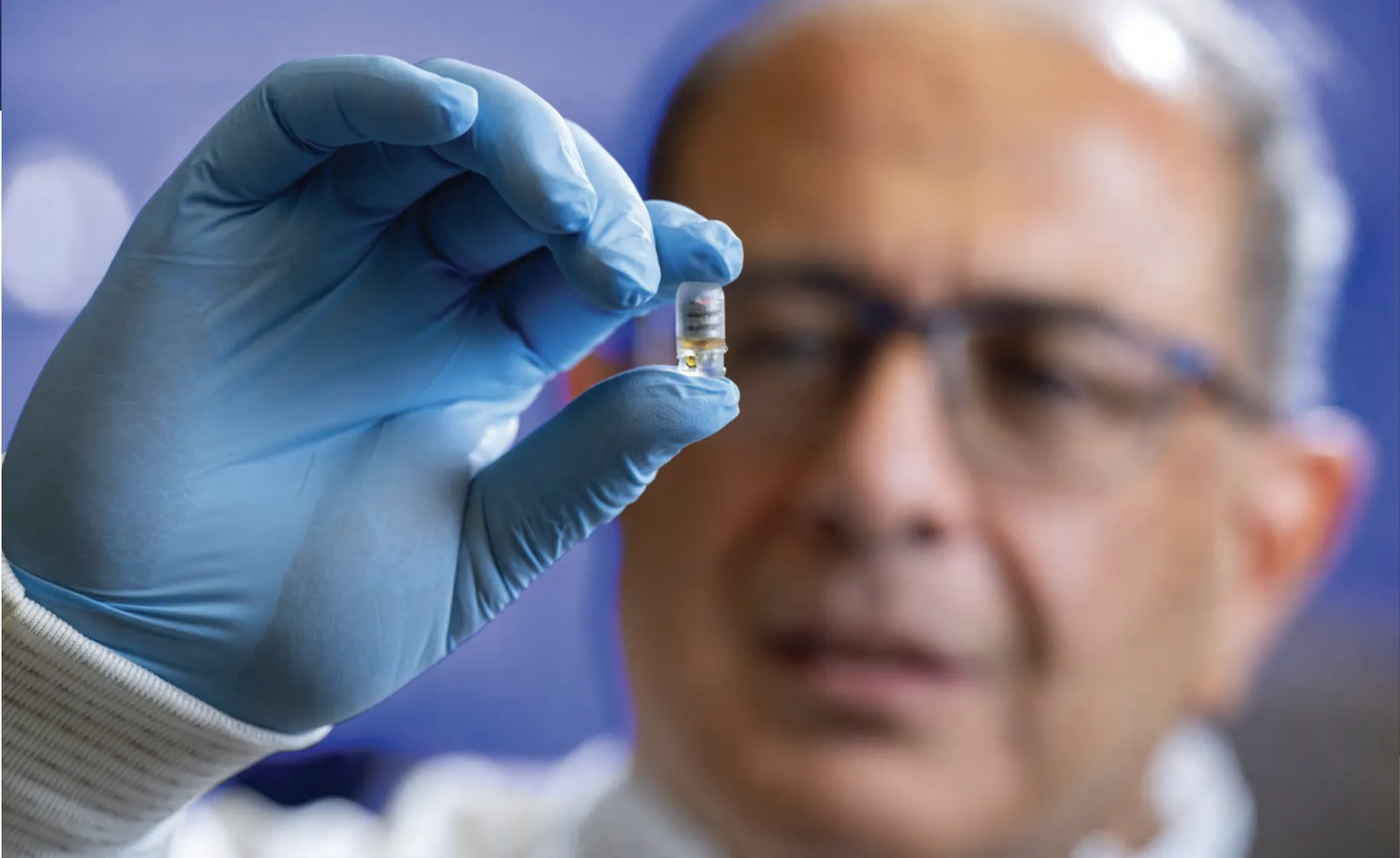
University of Maryland researchers are making substantial progress on an ingestible capsule designed to make gastrointestinal (GI) disease testing and diagnosis more accessible and affordable. With advances in tissue sampling and monitoring, the gut-monitoring “smart pill” is moving closer to providing an alternative to invasive procedures such as endoscopies. The capsule is designed to autonomously detect early signs of disease and monitor tissue health.
The team recently received two U.S. patents covering technologies that advance the “smart pill” and co-authored two journal papers describing the inventions and the data collected using them.
“These advancements represent an important step toward autonomous ingestible biopsy systems that could one day reduce the need for conventional endoscopic biopsies,” said UMD Distinguished University Professor Reza Ghodssi, a member of the University of Maryland Center of Excellence in Microbiome Sciences whose name appears on both patents. “The work highlights how advances in microsystems engineering and additive manufacturing can unlock new capabilities for biomedical devices. We’re excited about the potential for smart ingestible technologies to transform the diagnosis and monitoring of GI diseases.”
The first patent, “Bioimpedance Sensor-Integrated Capsule for Monitoring,” covers a device that measures the bioimpedance of tissue in areas such as the GI tract. Using microfabricated sensors and embedded circuitry, the device sends harmless electrical currents through tissue and records voltage measurements that reflect the tissue’s dielectric properties. It then processes the results and transmits them to a phone via Bluetooth. The technology enables noninvasive examination of the small intestine and direct measurement of inflammation in intestinal tissue.
A paper published in Cell Press’ journal Device introduces the bioimpedance-measuring capsule and presents data collected with it. It is the first journal publication co-authored by Mateo W. Lim, an M.S. student in electrical and computer engineering and a member of the “smart pill” team.
“Our group is making important strides towards noninvasive detection of gut inflammation,” said Lim, the paper’s lead author. “This technology has promising applications for autonomous health monitoring and drug delivery. It integrates aspects of additive manufacturing, electronics, and sensor design to create a system.”
The second patent addresses the challenge of collecting tissue samples autonomously while operating on the limited power available from a tiny capsule battery. Previous systems have struggled to collect meaningful samples under those constraints. The UMD team developed a more energy-efficient capsule that uses a melting adhesive to activate its tissue scraper.
That invention has been patented as “Integrated Capsule System for Real-Time Bioprocess Monitoring and Method of Using the Same.” The apparatus monitors bioprocess parameters in stirred-tank bioreactors. Its prototype houses a dissolved-oxygen sensor, a power supply and an electronics module that communicates with an external receiver. The unit also supports wireless communication, using Bluetooth Mesh protocols to create a sensor network. A paper published in the IEEE Journal of Microelectromechanical Systems describes the device.
“GI biopsy can be an intense process for patients and must be conducted by highly skilled medical professionals. That’s why I’m excited about the results of this work,” said Michael A. Straker, a bioengineering Ph.D. student and lead author of the IEEE journal paper. “We are inching closer to a world where these monitoring devices can be more accessible, taken more regularly, and hopefully help facilitate early disease detection and prevention.”
—Story adapted from two articles by the Clark School of Engineering