
Whether through his research or his many travels across the world, Nick An, third-year Ph.D student in the Department of Global, Environmental, and Occupational Health (GEOH) studying environmental health sciences, is all about community.
“In public health especially, we recognize that health issues aren't something that's just at the individual level,” said An, a native of Irvine, CA. “There's something underlying, something systemic that can affect multiple groups of people at once.”
An is focused on the intersection of public health with environmental science. He is in the Water Quality, Outreach and Wellness Lab (WOW Lab), led by Rachel Rosenberg Goldstein, an associate professor in GEOH, which brings together professors and a range of students to engage in community-engaged research studying water quality. An was also project manager of the Water Emergency Team (WET) for a year.
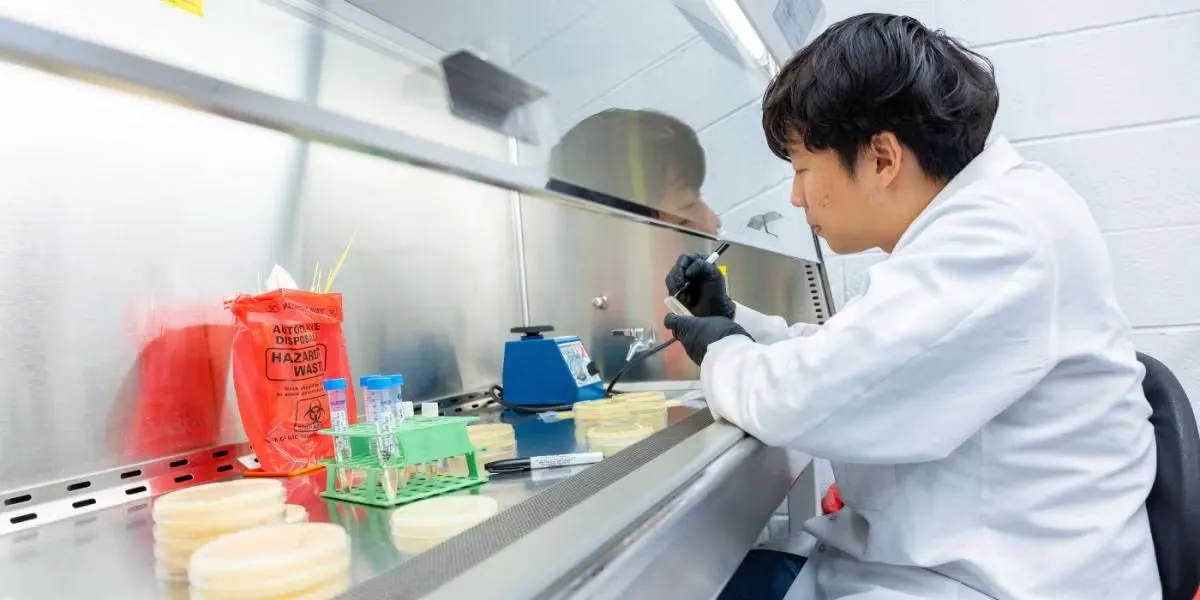
“In WET, we focus on sewage overflows and understanding people's potential exposure to microbial hazards as a result of them, specifically in households where people live and streams where people recreate,” An said.
“Nick always goes above and beyond, whether this means attending community outreach events on nights and evenings or teaching himself new skills like bioinformatics,” said Rosenberg Goldstein. “I have been so proud and impressed with the work that he has done while at UMD.”
WET is both interdisciplinary and community-focused, An said. The team creates report cards for the houses they visit, detailing what bacteria they find, with a goal of expanding outreach into town hall meetings for neighborhoods to learn more about the findings.
“You can't ignore the physical environment in which communities live, or how even historical practices like redlining contribute to health disparities,” An said, noting that that redlining is the illegal practice of refusing to offer credit or insurance in a particular community on a discriminatory basis.
An is also a fellow at UMD's Center of Excellence in Microbiome Sciences, an interdisciplinary center that unites researchers studying how microbial communities shape human, animal and environmental health.
An also did research with the UMD Global STEWARDS program, studying the risks of biodigesters in rural Nepal, which generate gas and fertilizer for households but can also create microbial hazards.
An received a bachelor’s degree in environmental science at Emory University, and later combined environmental health with public health when completing his master’s at Emory.
His curiosity has led him to various experiences around the world while completing his studies.
“I got scuba certified to look at coral reefs one summer in Belize,” An said of his college experiences. “I went to Madagascar to do some work on fleas and how they can inform how the plague spreads.”
After these travel experiences, An realized public health is both global and local. So, he moved closer to home for his Ph.D and shifted his focus to issues in Baltimore and surrounding areas.
An also enjoys exploring what this region has to offer, finding a new hike every chance he gets. One of his favorite hikes is at Mary’s Rock, a mountain found in the interior of Shenandoah National Park in Virginia. He also enjoys running and playing the board game Catan with friends.
In the future, An plans to keep connecting and working with others outside of his direct field to tackle health disparities.
He gave the following advice to other students:
“There's definitely lessons that you can learn from every single experience that you have. So, just start with what you're most interested in and then network around to see how you can get those experiences, and then go from there.”
—Story by Rachel Kebler, School of Public Health